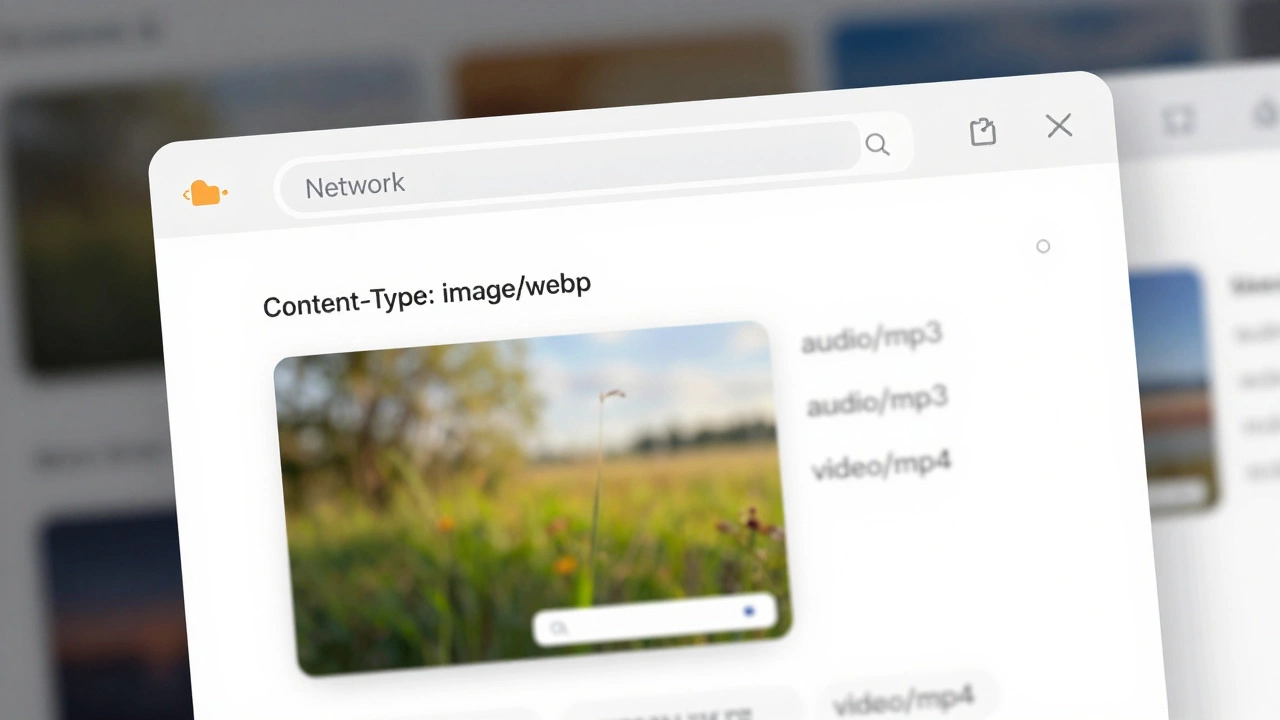
When someone asks, "What are the media types?" they’re usually trying to understand how different kinds of content are classified-especially online. It’s not as complicated as it sounds. Media types are just labels that tell computers what kind of file they’re dealing with. Think of them like tags on a suitcase: "image," "video," "audio," "text." These tags help your browser, phone, or app know how to open and display the file correctly.
For example, if you click on a photo on a website, your browser reads the media type as image/jpeg and knows to show it as a picture. If it’s a song, the media type might be audio/mpeg, and your device plays it through speakers. Without these labels, everything would just be a jumble of unreadable code. You’ve probably seen these codes in the background without realizing it. They’re the reason your video doesn’t turn into a mess of numbers when you hit play.
There are hundreds of media types, but only a few are used regularly. The most common ones are:
text/html- for web pagesimage/pngandimage/jpeg- for photosvideo/mp4- for most online videosaudio/mp3- for music and voice recordingsapplication/pdf- for documents like invoices or manuals
These are standardized by the Internet Assigned Numbers Authority (IANA), which keeps a public list of all official media types. It’s like a global dictionary that everyone follows so your phone doesn’t try to play a PDF as music.
Why media types matter more than you think
You might think media types are just technical details for developers. But they affect your everyday experience. If a website sends you a file with the wrong media type, your browser might not know what to do. You could end up seeing garbled text instead of a photo, or your video might not load at all. That’s why web developers pay close attention to them.
Media types also help with security. Browsers use them to block dangerous files. For example, if a website tries to send you a file labeled as image/jpeg but it’s actually an executable program, your browser can flag it as suspicious. That’s one reason your antivirus doesn’t always go off when you download a picture-it knows the file type matches what it claims to be.
Another hidden use is in email. When you attach a file to an email, your email client tags it with a media type so the recipient’s system knows how to handle it. Without that tag, your PDF might arrive as an unreadable blob. That’s why some older email systems struggle with attachments-they don’t recognize newer media types.
How media types work behind the scenes
Every time you load a webpage, your browser sends a request to the server. The server responds with headers-small pieces of data that tell the browser what’s coming. One of those headers is called Content-Type, and it includes the media type.
For example:
Content-Type: image/webp
This line tells your browser: "Here’s a WebP image. Render it as a picture." The browser then uses its built-in image decoder to show it. If the server accidentally says Content-Type: text/plain for the same file, your browser will display the raw image data as text-lots of strange symbols and no picture.
That’s why webmasters use tools like Apache or Nginx to make sure the right media types are assigned automatically. Many content management systems handle this for you, but if you’re uploading files manually to a server, you might need to check the settings.

Common mistakes and how to fix them
One of the most frequent errors is assigning the wrong media type to a file. For instance, someone might rename a .mp4 file to .mov and assume it’ll work the same. But if the server still sends it as video/mp4, some devices might not play it. The file extension and the media type must match.
Another issue is missing media types entirely. If a server doesn’t send a Content-Type header at all, browsers will try to guess what the file is. This is called "sniffing," and while it sometimes works, it’s unreliable-and a security risk. Modern browsers are getting better at blocking this behavior.
If you’re a content creator or website owner, here’s what to do:
- Always upload files with the correct extension (.jpg, .mp3, .pdf)
- Use a reliable hosting platform that handles media types automatically
- Test your files in different browsers to make sure they load properly
- Don’t rename files just to make them look prettier-change the actual file format if needed
Media types and the future of digital content
As new formats emerge, so do new media types. WebP, AVIF, and HEVC are replacing older image and video formats because they’re smaller and look better. Each of these has its own media type: image/webp, image/avif, video/h265.
Streaming services like Netflix and YouTube rely heavily on these newer types to deliver high-quality video without using too much data. If you’ve ever noticed your video quality improving without changing your internet speed, it’s likely because the platform switched to a more efficient media type.
Even voice assistants and smart home devices use media types. When you ask Siri to play a song, it’s using a media type to tell your speaker what kind of file to stream. The same goes for Alexa playing a podcast or Google Home reading a news article aloud.
So while media types might seem like a boring technical detail, they’re quietly powering everything from your morning playlist to your evening Netflix binge.
For those looking for relaxation after a long day, options like thai massage dubai are popular in certain circles-offering a different kind of sensory experience, much like how the right media type ensures your digital content feels just right.

Real-world examples you can test right now
Here’s a quick way to see media types in action:
- Open any website in Chrome or Firefox.
- Right-click and select "Inspect" or "Inspect Element."
- Go to the "Network" tab.
- Refresh the page.
- Click on any image or video file in the list.
- Look for the "Content-Type" header in the right panel.
You’ll see exactly what media type your browser is using for each file. Try it on a site like YouTube or Instagram. You’ll notice most images use image/webp now, not image/jpeg. That’s because WebP is 30% smaller and just as clear.
Another example: download a file from a website and check its properties. On Windows, right-click the file > Properties > Details. On Mac, right-click > Get Info. You’ll see the file type listed. If it doesn’t match the extension, something’s off.
What you should remember
Media types are the invisible rules that keep digital content working. They’re not glamorous, but without them, the internet would be chaotic. Every time a photo loads, a video plays, or a document opens, a media type made it possible.
You don’t need to memorize all of them. But knowing how they work helps you troubleshoot problems, choose better file formats, and understand why some things just won’t open on your device.
And if you’re ever confused about why a file isn’t playing, check the media type first. It’s usually the culprit.
For those seeking physical relief, a good body massage can be just as essential as the right media type is for your digital files-both restore balance, reduce stress, and improve overall function.
Some people turn to specialized treatments like nuru massage for a different kind of sensory experience, though it’s important to research local regulations and providers carefully.